PV surplus charging
When the roof is producing more than the house needs, extra solar can go into the EV instead of being exported or wasted. That is one of the clearest benefits of tying charging to the same stack as the inverter and battery.

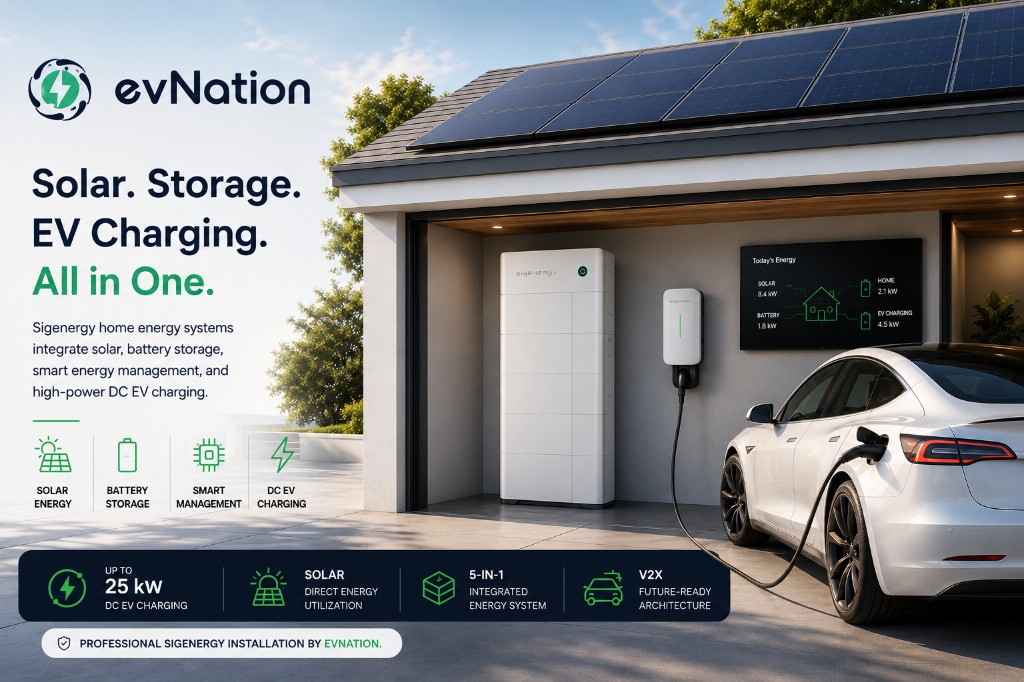
Sigenergy × EVnation
Most homes treat solar, batteries, and EV charging as three separate projects. Sigenergy puts them on one platform — so surplus solar can charge the car, stored energy can cover the house, and charging is coordinated instead of fighting the rest of the load. EVnation designs and installs it around your panel, roof, and driving pattern.
View Sigenergy product brochure (PDF)25 kW
DC EV charging
High-power home charging instead of a standard AC wallbox.
5-in-1
Integrated system
Solar, storage, energy management, backup, and EV charging in one stack.
Solar-first
Energy utilization
Send extra PV into the battery or the car before exporting it.
V2X
Future-ready
Architecture prepared for vehicle-to-home and vehicle-to-grid.
Why one system
SigenStor is the energy hub of the home. Solar production, battery storage, household loads, and EV charging are planned together — so you get more from the same kilowatt-hours.

SigenStor — the home energy hub
A typical setup is a solar inverter, a battery, and an AC charger that barely talk to each other. SigenStor is the hub — solar, storage, home loads, and EV charging share one energy plan instead of competing for the same panel.
When the roof is producing more than the house needs, the extra energy can go into the battery or straight toward DC EV charging. That is the point of an integrated system: use the power you already paid to generate.
Power is coordinated across solar, battery, and the grid. Charging can draw from what is available rather than slamming a fixed AC circuit while the dryer, HVAC, and kitchen are also on.
EVnation sizes the stack to your roof, main panel, parking, and how you drive. You are not stitching a solar contractor, a battery vendor, and an EV electrician after the fact.
Solar-powered mobility
Generate. Store. Drive. That is the loop an integrated home energy system is built for — more of your roof production ending up in the vehicle, with the house still covered.
01
Rooftop solar produces clean power during the day. In a typical home, a lot of that surplus is exported or unused because the charger and the battery are not part of the same plan.
02
SigenStor holds extra solar for evening loads, backup, and later charging. You keep more of your own generation on-site instead of buying it back from the grid at peak rates.
03
When you plug in, available solar and stored energy can go toward the EV — coordinated with what the house still needs. The car becomes another load on the same intelligent system, not a separate project.
High-power home charging
A standard AC wallbox is a separate appliance. Sigenergy’s DC path is part of the energy system — so charging can use solar and storage, not only a dedicated grid circuit.
DC charging at home is the practical upgrade for drivers who want a meaningful session overnight or between trips, without treating the garage as a public fast-charge stall. Available power is coordinated across solar, battery, and the grid.
Performance depends on the vehicle, the stack configuration, and what else the home is drawing. EVnation sizes the install so charging is fast where it can be — and safe for the panel.
Traditional
Sigenergy
Grid-only AC wall charger
Solar + battery + grid, coordinated
Typical Level 2 speeds
Up to 25 kW DC at home
Separate from solar and storage
Same stack as the rest of the home
Fixed circuit, little load awareness
Power shared with household loads
Actual charging performance depends on vehicle compatibility, system configuration, available power, and installation conditions.
Not another wallbox. A home energy system that treats the EV as part of how the house makes, stores, and uses power.
When the roof is producing more than the house needs, extra solar can go into the EV instead of being exported or wasted. That is one of the clearest benefits of tying charging to the same stack as the inverter and battery.
Stored energy can work with live solar and the grid as one charging source. You are not limited to whatever a single AC circuit can spare while the rest of the home is running.
Solar, storage, household loads, and EV charging share one control plane. The system can prioritize the house, hold reserve in the battery, and still move energy into the car when it makes sense.
The platform is built with vehicle-to-home and vehicle-to-grid in mind — so the install is not a dead-end AC wallbox when those use cases become available for your vehicle and utility.
Availability depends on compatible vehicles, local rules, system configuration, and supported functionality.
Sigenergy supplies the integrated platform. EVnation makes it fit the panel, the roof, and the way you actually use the house.
Sigenergy
A 5-in-1 home energy stack: solar conversion, battery storage, intelligent energy management, backup capability, and DC EV charging in one architecture — so you are not gluing three brands together in the garage.
View Sigenergy product brochure (PDF)EVnation
Licensed electricians who already live in EV charging, panel upgrades, and energy installs. We size conductors, protection, and placement so the system looks finished and behaves the way the brochure promised.
Panel capacity, roof production, parking, and how often you drive all change the right stack. We design the Sigenergy layout for this home — not a catalog default.
EVnation is a licensed electrical contractor. The work is built for inspection, labeling, and a clean finish in the garage — the same standard we use on charger and panel jobs.
You do not have to sequence three trades. One team plans the energy path from the roof to the battery to the car.
We handle the paperwork path that usually stalls homeowners: permits, interconnection details, and a system that is meant to pass inspection the first time.
Built for
You already generate power. An integrated stack is how more of it stays on-site — in the battery or in the car — instead of leaving as cheap export.
Home charging should not be a second electrical project. Bring the vehicle onto the same system as the house so charging speed and household loads are planned together.
Storage is more useful when it is not an island. Coordinate what the battery covers — lights, well pump, or a portion of charging — with a real design, not a guess.
Solar × Storage × EV
If you want solar, backup, and home EV charging to work together — not as three invoices — start with a Sigenergy design from EVnation. We will tell you what fits your panel and what the install actually includes.
View Sigenergy product brochure (PDF)866-913-6199